
Nacogdoches County Court Record Requests
Every Nacogdoches County court record request begins with a court name. District Clerk records cover the 145th and 420th District Courts. Those courts handle felony, major civil, family, juvenile, and other district matters. The County Clerk holds County Court at Law and probate files. Each Justice of the Peace keeps its own precinct records. Municipal courts retain their city cases. Send your request to the wrong clerk. Even a correct cause number will not save you the delay.
For online access, re:SearchTX lists cases and hearings from participating courts. Nacogdoches County shows limited public search there. So a missing result does not prove the court record is absent. The County Clerk's Publicsearch system covers recorded instruments only. It is not a full viewer for district, county, JP, or municipal case files.
- Identify the court, case or cause number, and the exact filing or order needed.
- Check re:SearchTX for a case entry or document image when that court participates.
- Contact the proper clerk by phone or email to confirm custody and current access.
- Request inspection in person, or send a precise request by mail, email, or fax.
- Ask for a plain or certified copy, then obtain the current fee, payment, ID, and delivery terms.
The county publishes no universal copy-order form, turnaround promise, drop box, or public-terminal policy. Ask the clerk what exists before you send payment. A good request names the court, the cause number, the case style if known, the document title, the filing date, your contact details, whether you want certification, and how the copy should reach you.
Nacogdoches Records Use Two Clerks
Two clerk offices share one courthouse but split the court files between them. District Clerk Loretta Cammack's office sits in Room 120. The address is 101 W Main Street, Nacogdoches, Texas 75961-4832. Call 936-560-7740, fax 936-560-7839, or email dclerk@co.nacogdoches.tx.us. That office anchors Nacogdoches County records for district criminal and civil matters.
County Clerk Sandra Yates works from Room 110. The address is 101 W Main Street, Nacogdoches, Texas 75961. Her phone is 936-560-7733 and fax is 936-559-5926. County Court at Law, probate, and the other county-level categories start there. JP and municipal records stay with their own courts. That holds no matter where in Nacogdoches County the case arose.
Nacogdoches County District Clerk
101 W Main St., Room 120
Nacogdoches, TX 75961-4832
936-560-7740
dclerk@co.nacogdoches.tx.us
Nacogdoches County Clerk
101 W Main St., Room 110
Nacogdoches, TX 75961
936-560-7733
Kinds of Court Records
Nacogdoches County court case records are not one document. The docket is a running index of activity. Filed papers sit behind that index when they are public and available. A clerk's certification turns a copy into an authenticated court product. So match the product to the need. That might mean tracking a case, reading a ruling, or holding a formal copy from the court.
- Docket sheets and chronological case-register entries
- Petitions, complaints, answers, motions, notices, and returns
- Signed orders, judgments, dispositions, and abstracts
- Public exhibits and attachments held with a case file
- Plain copies, certified copies, and separately ordered transcripts
Family, juvenile, sealed, and sensitive-data rules can limit what the public receives. An entry may be visible while its linked image stays restricted. A file can also live on paper, microfilm, or in storage and never appear in the public search layer.
Nacogdoches Docket, Filing, Certification
Three terms clear up most confusion in a Nacogdoches County record request. A docket lists activity by date. A filed document holds the actual text of a motion, pleading, notice, or order. A certified copy bears the clerk's certification or seal. Printing an online PDF does not create one.
- Docket or register
- The court's time-ordered list of filings, hearings, orders, and outcomes.
- Filed document
- The petition, motion, answer, exhibit, order, judgment, return, or notice behind an entry.
- Certified copy
- A reproduction authenticated by the clerk for a use that calls for proof of authenticity.
- Transcript
- A written record of spoken court proceedings ordered from the court reporter, not the clerk.
That is why a free search result can still cost money. re:SearchTX shows case details and may sell a document. A downloaded page is not a clerk-certified copy.
Court Records: What They Contain
Most Nacogdoches County court records open with a cause number. Then come the court, case style, filing date, and status. From there it can list parties and lawyers. It may also show a dated run of docket entries, settings, signed orders, financial events, and a disposition. Fields differ because NetData, re:SearchTX, municipal reports, and paper files are separate layers. The county publishes no countywide codebook or universal cause-number format. Copy the identifier exactly as the clerk, citation, or portal shows it.
| Case Number | The court-assigned cause, case, citation, or docket identifier; no sample format should be guessed. |
|---|---|
| Pleadings | Petitions, complaints, motions, answers, returns, and notices filed by a party or agency. |
| Orders & Judgments | Signed rulings, judgments, disposition records, and related enforcement documents. |
| Docket Sheet | A chronological index that links dates with filings, settings, orders, and outcomes. |
| Exhibits | Attachments or trial material when filed, retained by the clerk, and open to public access. |
Want the full event history? The Nacogdoches County Docket Search route breaks down the difference between county and statewide tools. Before ordering any copy, match the document title and filing date first.
Nacogdoches Records Have Digital Layers
NetData, eFileTexas, and re:SearchTX each do a different job. State clerk directories name NetData as the local case-management system. eFileTexas is the filing channel, and Nacogdoches lists mandatory civil filing for district, county, and probate categories. re:SearchTX supplies statewide case and hearing data from participating courts. Its official guide covers case details, filings, documents, alerts, exports, and purchases.
| System | Main Role | Public Limit |
|---|---|---|
| NetData | Local case-management label in clerk directories | No complete county public codebook or open interface was verified |
| eFileTexas | Electronic filing for participating Texas courts | Filing access is not the same as a complete public docket |
| re:SearchTX | Statewide case, hearing, and possible document access | Nacogdoches public search is listed as limited |
The official manifest of the re:SearchTX court-record search shows the statewide layer at work. It is not a complete Nacogdoches County case file.
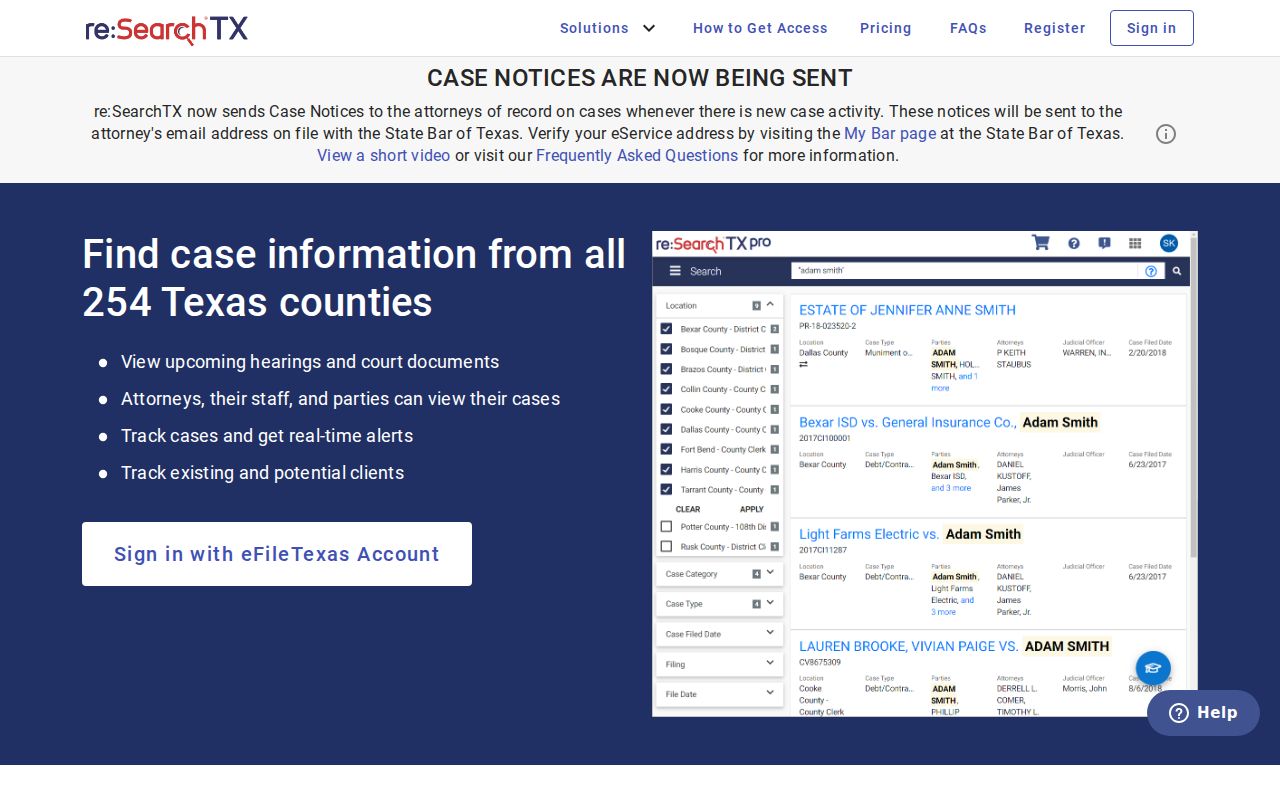
A blank result is a sign to call the right clerk. It is not proof that no record exists.
Copy Fees and Certification
A plain copy just reproduces the file. A certified copy carries the clerk's authentication instead, which is what most agencies want. Texas Government Code Chapter 51 offers helpful statutory reference points, though Nacogdoches County posts no single form that fixes the price, method, ID rule, or turnaround for every court record. Get a quote from the right clerk before you order.
| Item | State Reference |
|---|---|
| Paper or converted electronic noncertified copy | Generally $1 per page |
| Electronic document up to 10 pages | Generally $1 |
| Electronic document over 10 pages | Generally $0.10 per page |
| Certification and seal component | Generally $5, plus applicable copy charge |
| Transcript | Court reporter quote; no local fee was located |
Filing charges from the County Clerk are a separate thing from copy prices. Petition, probate, writ, and citation fees all belong to that group. The same goes for re:SearchTX. It charges $0.10 per page with a $1 minimum per document. Those portal fees cover online purchases only, not certification by the clerk. For the real cost of your request, get a quote from the clerk's office.
Note: An online PDF is not certified. The clerk must supply the required certification or seal.
When a Nacogdoches File Is Missing
When a document link is missing, write down the exact docket entry first. Include the date, the court, and the cause number. Then ask the custodian whether the item is not digitized, stored elsewhere, sealed, redacted, or held by another office. A phone call can find the right desk fast. Email, fax, or mail leaves a written description you can point back to. For a large or old file, an in-person look may work best; the county publishes no current policy on terminal access or same-day service.
Request fields: Give the court, cause number, case style, document title, docket date, plain-or-certified choice, delivery preference, and requester contact information.
For older Nacogdoches County records, check with the clerk before anyone calls an archive. Custody shifts over time. The SFA East Texas Research Center finding aid covers county, district, justice, commissioners, and city records from 1826 through 2012. It warns that early birth and death books went back to the County Clerk in 2023. They are vital records. So the office you assume has the file may not.
Access Rules for Court Records
Public access does not mean every page is open without limits. Texas treats case records and non-case judicial records differently. Courts follow the Texas Judicial Branch open-records policy. They are not generally governed by the Texas Public Information Act for judicial and case records. A request for a case file goes to the clerk who maintains it. Rule 12 handles judicial records beyond case records. It sets out a custodian and an appeal process.
Key Rules:
Texas Judicial Branch Rule 12 governs public requests for non-case judicial records and requires enough detail to identify the record.
Texas Government Code Chapter 51 provides clerk-copy and certification fee references.
Texas Rules of Civil Procedure 21c and 76a address sensitive-data redaction and the standards for sealing civil court records.
Texas Family Code Chapter 58 protects juvenile records and limits access.
Fine-only juvenile restrictions under Chapter 45A sit on a separate track. A court may redact protected data. It can also withhold a sealed filing or require proof of authorized access. No certified-copy request can override those limits. Transcripts come from the court reporter. Exhibits may sit with the clerk, the reporter, or another trial-file custodian.
Nacogdoches Transcripts Use Another Custodian
A docket entry saying a hearing happened is not a transcript of what was said. The clerk keeps the docket and the filed orders. The official court reporter prepares the transcript. The state personnel directory lists a reporter for the 420th District Court, but confirm the current assignment and price with the court for the proceeding you need. The county publishes no official transcript fee.
Ask the court which reporter covered the hearing date, then get a quote and delivery terms from that reporter directly. Exhibits travel their own path. Some are filed with the clerk; others stay in a reporter or trial exhibit system. This quick custodian check saves you from paying for a certified docket sheet when what you really want is the spoken record or an exhibit.